

WE WELCOME OUR NEW SITE SPONSOR CAPITAL ONE!
 CLICK HERE TO DONATE TO HELP FUND THIS SITE!
NEW CLICK HERE TO SEND US A GIFT! A COOL IDEA TO HELP US FOR HELPING YOU!

NEW CLICK HERE FOR THE AMAZON PRIME PAGES!
NEW CLICK HERE FOR HOLIDAY CARDS AND WRAPPING PAGES
NEW CLICK HERE FOR THE UPS PAGES
NEW CLICK HERE FOR THE 2000 4.1 TOYOTA RAV4 PAGES
NEW CLICK HERE FOR HOME AUTOMATION PAGES ALEXA AND FIRE TV AND GOOGLE HOME ITEMS
NEW CLICK HERE FOR Y 3 K PAGES
NEW CLICK HERE FOR THE HOUR METER PAGE
CLICK HERE FOR THE FITTINGS ID PAGES FOR HOSES AND PORTS
NEW CLICK HERE FOR HYD ORINGS PAGES
CLICK HERE FOR THE BIG SHOP TOOLS PAGES
CLICK HERE FOR THE LISLE TOOLS PAGE
CLICK HERE FOR THE THREAD SIZE PAGE
CLICK HERE FOR THE BOLT TORQUE PAGE
CLICK HERE FOR CONSTRUCTION PAGES
CLICK HERE FOR THE WIND POWER PAGES
CLICK HERE FOR HEALTH CARE PAGES
CLICK HERE FOR TV ANTENNA AND ROTOR PAGES
CLICK HERE FOR THE ELECTRONICS PAGES
CLICK HERE FOR THE SAFETY PAGES
NEW CLICK HERE FOR LOCKS PAGES
CLICK HERE FOR IPAD IPHONE PAGES
CLICK HERE FOR THE TRACK AND TELL PAGES
CLICK HERE FOR WORK CLOTHING PAGES
CLICK HERE FOR THE LITHIUM RECHARGEABLE BATTERY PAGES
CLICK HERE FOR THE EMERGENCY LIGHTS PAGES
CLICK HERE FOR THE BELT ALIGNMENT PAGES
CLICK HERE FOR THE HVAC AIR CONDITIONER PAGES
NEW CLICK HERE FOR THE HOT WATER HEATER PAGES WITH RECIRCULATION PUMPS
CLICK HERE FOR THE WINDOW TINT PAGE WITH BLACK OUT TINT TOO!
CLICK HERE FOR THE CAMPER TRAILER LIGHTS WIRING DIAGRAM PAGE
CLICK HERE FOR THE TRAILER TOW PAGES
NEW CLICK HERE FOR THE DIESEL REPAIR PAGES
IECO 210 HP 4 CYL / POUSTUSA CHEVY VEGA PAGE
RADIO SERVICE RADIO CONVERSION AND MORE
SALVAGE YARD LINKS STATE BY STATE LISTINGS

CLICK HERE FOR EQUIPMENT AND SMALL ENGINE PAGES WITH LINKS HONDA PAGES TOO AND HOW TO!!
CLICK HERE FOR THE MOUSE TRAP PAGES A TRAP THAT WORKS FOR US!!
CLICK BELOW FOR THE COOL UNIT CONVERTER SITE
CLICK HERE FOR SHOP TOOLS AND EQUIPMENT PAGES
CLICK HERE FOR MUST HAVE TOOLS LIST PAGE
CLICK HERE FOR AIRCON SOFT START PAGES
CLICK HERE FOR THE INVERTER WINDOW AC UNITS
CLICK HERE FOR THE ELECTRICAL TOOLS AND PARTS PAGES AND MORE!
NEW CLICK HERE FOR RESTAURANT PAGES
NEW CLICK HERE FOR TRUCK CRAIN BED LIFTS
NEW AUXITO ULTRA BRIGHT LED LIGHTS

NEW SEAT BELTS FOR YOUR HOTROD AND MORE











CLICK HERE FOR THE POWER WASHER PAGES
CLICK HERE FOR THE DRAINZIT OIL DRAIN PAGES
CLICK HERE FOR THE DC FUSE PAGE ATO, ATC, MAXI, GMA
NEW CLICK HERE FOR THE SURVIVAL PAGES
NEW CLICK HERE FOR THE WIFI PAGES
NEW CLICK HERE FOR THE TOYOTA RAV4 PAGES
|
IDF / DCOE / IDA / 38 DGAS |
|
Addendum to lean Best Idle adjustments Notes and adjustments for IDF and DCOE Carburetors All adjustment procedures are the same as the
progressive carbs. It is important to understand the dynamic differences
of the two carb styles Progressive and Synchronous carbs Or
better described as individual runner carbs. Standard IDF & DCOE Settings |
|
|
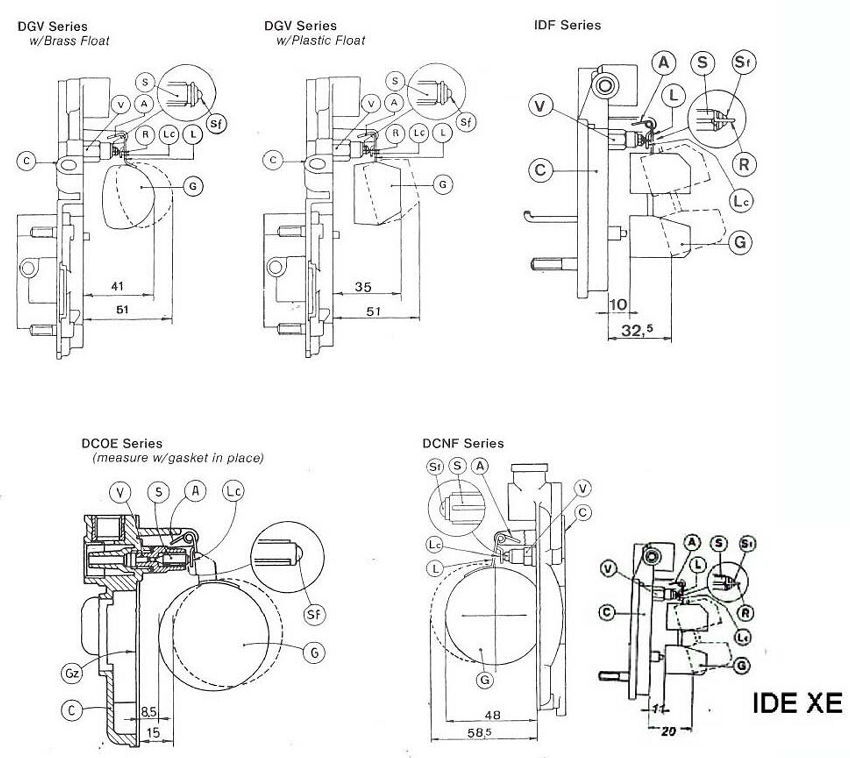
FLOAT LEVEL - DGV / IDF / DCOE / DCNF / IDE-XE
The float level is a critical part of carburetor calibration. Changing the fuel level in the bowl will change the point that the main circuit starts to feed, alter the characteristics of an emulsion tube, and affect drivability and fuel consumption. GENERAL INSTRUCTIONS: Float level, in mm, typically refers to the distance from the face of the carburetor top cover to the float. With the top cover held vertically (float pivot at the top) and the float tab (Lc) resting against, but not depressing the spring loaded ball in the needle valve, measure between the face of the carburetor top cover to the top or bottom of the float. On carburetor models where it is required to remove the float to replace the top cover gasket, the measurement should be made with the gasket in place to the gasket face. |
|
|
|
DCOE |
|
|

















![[Most Recent Quotes from www.kitco.com]](http://kitconet.com/images/quotes_7a.gif)